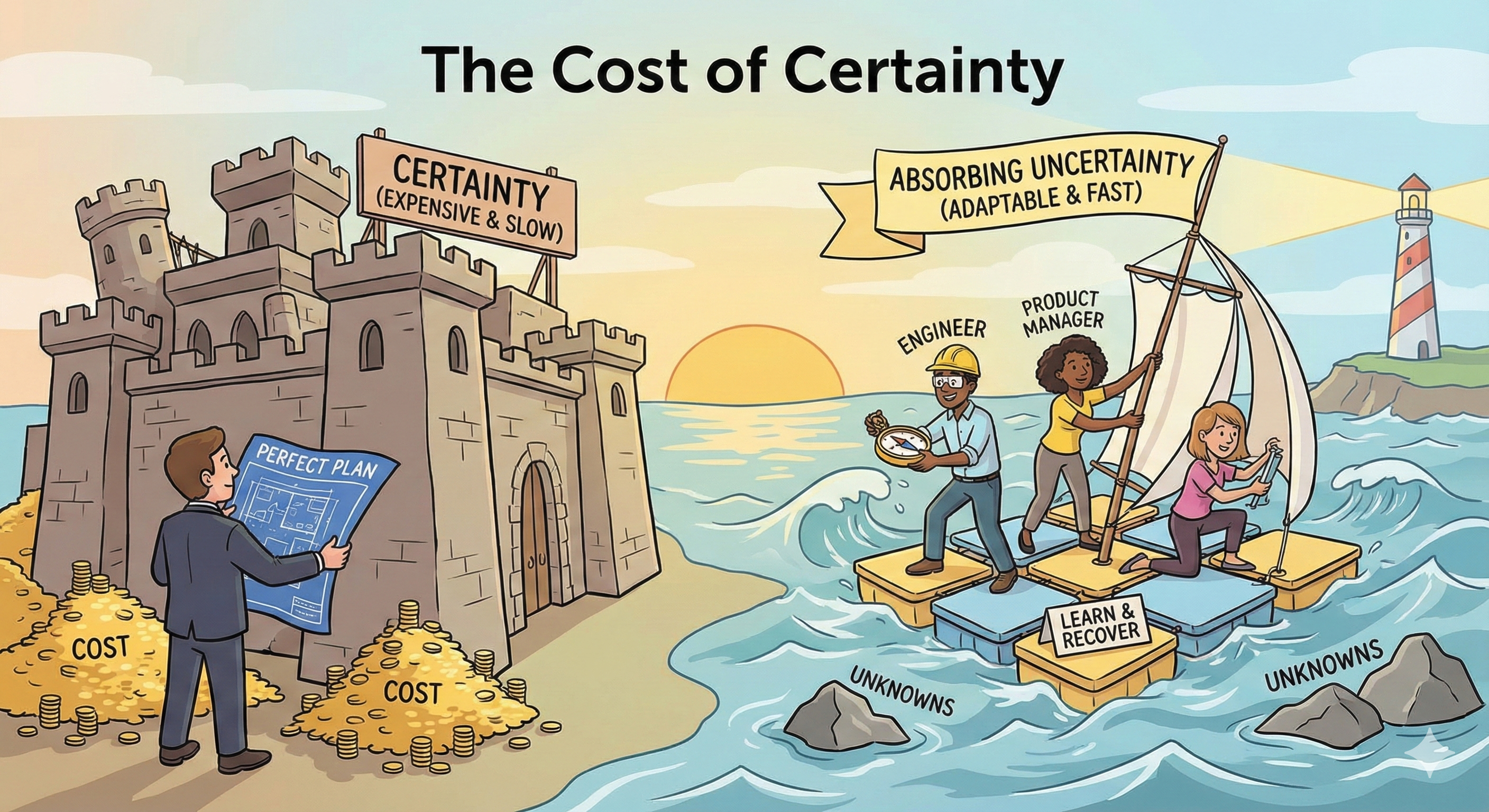
The Cost of Certainty (and Why the Best Teams Avoid It)
Certainty feels like rigor but eliminating uncertainty is a false optimization. Learn why strong teams absorb uncertainty rather than fight it, and how weak systems respond to unpredictability.
In the first two articles, I argued that great products are built through tradeoffs; and that most of the real friction in product, engineering, and business comes from unknowns, not incompetence.
This article attempts to complete that thought.
Because once teams accept that uncertainty is unavoidable, a new failure mode appears: the temptation to eliminate it.
That instinct is understandable. It's also incredibly expensive.
Certainty Is a False Optimization
Certainty feels like rigor:
- Perfect requirements
- Locked roadmaps
- Fully scoped architectures
- "No surprises" delivery plans
But certainty is not an input. It's an output; and only after reality has been allowed to push back.
When teams demand certainty upfront, what they're really saying is:
"We'd rather delay learning than risk being wrong."
That tradeoff doesn't reduce risk. It just postpones visibility.
Where the Pursuit of Certainty Quietly Hurts Teams
Certainty usually enters the system wearing a disguise.
In Product
- "Let's not ship until we fully understand the customer"
- "We need more validation before committing"
- "We can't change scope mid-cycle"
The result isn't better product. It's product that lags reality by months; and nobody notices until churn, adoption, or sales friction spikes.
In Engineering
- "We should design this for all future use cases"
- "Let's refactor first so we don't accrue debt"
- "This needs to be more elegant before it ships"
The system becomes internally coherent; and externally misaligned.
In Leadership
- "Let's wait for alignment"
- "We need more data"
- "We should socialize this more"
Decisions decay into consensus theater. Velocity slows without anyone explicitly choosing it.
This Doesn't Change With Company Size
A common mistake is assuming this philosophy only applies to startups.
It doesn't.
Startups don't have a monopoly on uncertainty. Enterprises don't have a monopoly on rigor.
What changes as companies scale is the blast radius, not the underlying dynamic.
Startup
- What's different? Low external cost of mistakes
- What's the same? The future is still unknowable
Mid-size
- What's different? Customers depend on you
- What's the same? You're still guessing; just with more data
Enterprise
- What's different? Trust and uptime are existential
- What's the same? Behavior and usage are still unpredictable
No organization ever graduates from uncertainty. They only graduate into more expensive ignorance.
This Is Not "Fail Fast" or "F*** It, Ship It"
Those slogans confuse speed with learning.
This isn't about recklessness. And it's definitely not about carelessness.
Mature teams don't fail fast. They fail contained.
They don't ship impulsively. They ship reversibly.
The goal isn't speed for its own sake. The goal is early, honest signal; without burning trust.
Strong Teams Don't Reduce Uncertainty — They Absorb It
This is the real dividing line.
Weak systems try to eliminate uncertainty. Strong systems are built to absorb it.
You see this in:
- Modular architectures
- Loosely coupled teams
- Feature flags and dark launches
- Reversible decisions
- Explicit kill-criteria for projects
- Time-boxed bets instead of permanent commitments
Different tactics at different scales. Same philosophy everywhere: learn without destabilizing the system.
What This Looks Like in Practice
- Startups use narrow rollouts, throwaway tooling, and aggressive iteration.
- Mid-market teams rely on backward-compatible changes, parallel systems, and clear cutover points.
- Enterprises use shadow traffic, staged migrations, and long deprecation windows.
The mechanics change. The constraint does not.
Rewrites Aren't Failures; They're Evidence of Learning
This ties directly back to the earlier articles.
Rewrites don't happen because teams "built badly." They happen because:
- the problem space evolved
- the business learned
- constraints changed
Enterprises rewrite too; they just call it "modernization," "platform investment," or "digital transformation."
The rewrite isn't the failure. Pretending a rewrite won't be necessary is.
The real mistake is building systems (technical or organizational) that make learning traumatic.
The Question High-Performing Teams Actually Ask
Instead of asking:
"How do we get this right?"
Strong teams ask:
"How wrong can we afford to be — and how fast can we recover?"
That single reframing drives:
- smaller bets
- clearer escape hatches
- calmer teams under pressure
- less ego, more iteration
It also creates organizations that don't panic when reality disagrees with the plan; because they expected it to.
Certainty Is Comfort. Progress Is Not.
Certainty feels responsible. Progress feels messy.
If your roadmap, architecture, or product strategy feels too clean, that's not a win; it's a warning sign.
The teams that scale aren't the ones that move fastest. They're the ones that never lie to themselves about how much they still don't know; even when the stakes get high.
And they build systems (human and technical) that can survive being wrong.
This series started with tradeoffs, moved through unknowns, and now lands on how teams respond when uncertainty refuses to go away.
There's more to explore here; especially around incentives, organizational design, and how teams accidentally optimize for the wrong signals as they grow.
More to come.