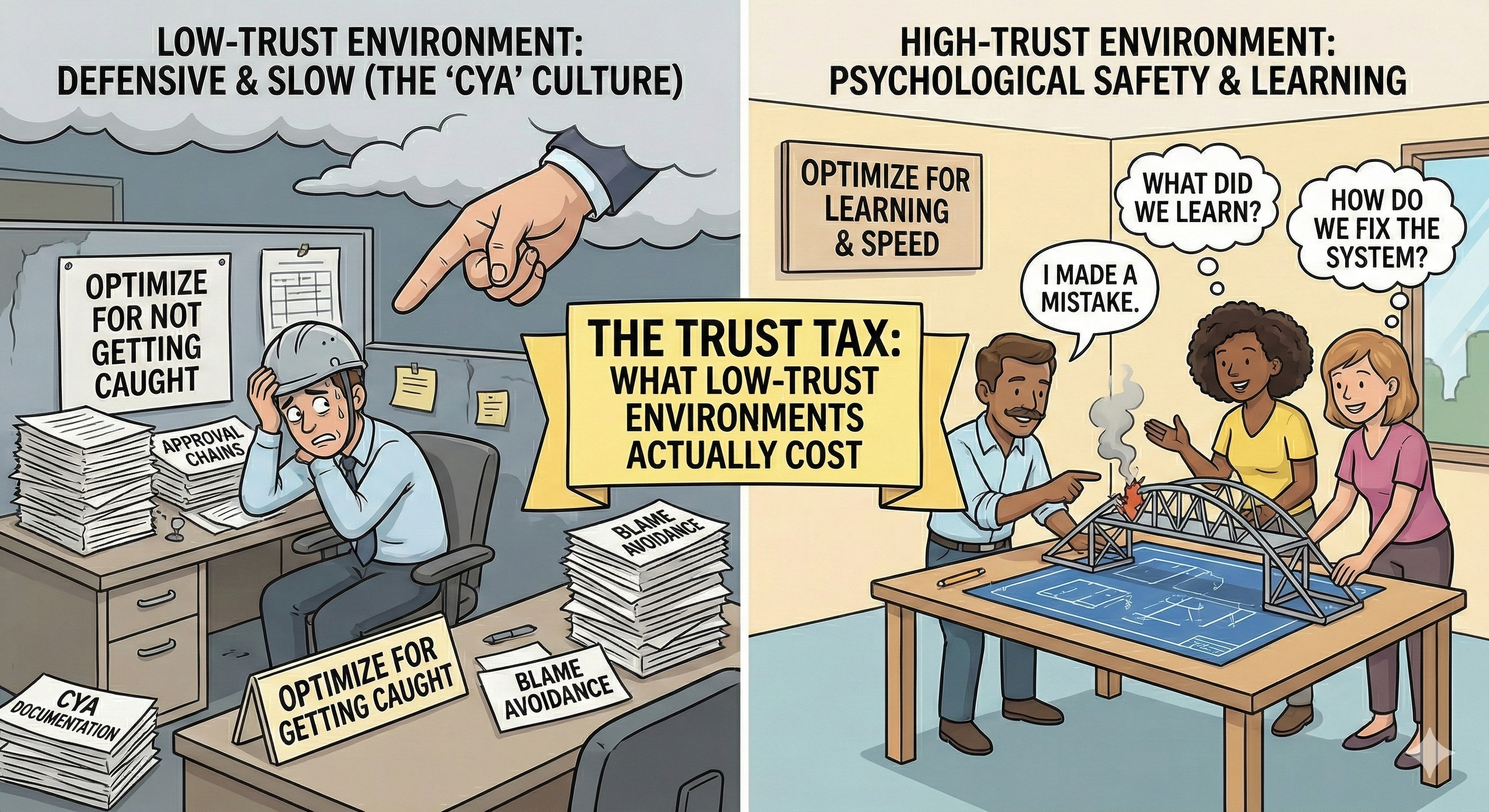
The Trust Tax: What Low-Trust Environments Actually Cost
Low-trust organizations pay a 40% performance penalty. Learn why trust—not process or talent—determines whether your product engineering succeeds or fails.
What Low Trust Actually Costs
Most teams know trust matters. Few understand how expensive the absence of it is.
The numbers are stark:
Performance and Productivity:
- Workplaces with low trust experience a 40% reduction in performance1
- High-trust organizations report 50% higher productivity2
- Disengaged employees—often a direct result of low trust—cost the global economy $8.8 trillion annually, roughly 9% of global GDP3
Retention and Turnover:
- High-trust organizations experience 50% lower turnover than their low-trust competitors2
- Replacing an employee costs 1.5 to 2 times their annual salary4
- In 2023, toxic corporate culture was 10 times more predictive of turnover than compensation5
The Hidden Overhead:
But those are just the visible costs. The real damage happens in the behaviors low trust creates:
1. Cover-Your-Ass Culture
When trust is low, people optimize for looking right over being right.
Research on defensive decision-making in organizations found that 80% of managers had made at least one defensive decision in the past year—and on average, 25% of their most important decisions were made to avoid personal repercussions rather than serve the organization's best interest6.
What this looks like in practice:
- Excessive documentation that no one reads, created solely to prove you did your job
- Shadow files—secret personal logs of interactions used as evidence in future disputes
- Email chains copying five people on routine decisions "just to be safe"
- Consultant theater—hiring external firms to validate decisions already made, providing a ready scapegoat if things go wrong
The time cost alone is staggering. Significant energy gets diverted from productive work to justifying decisions and covering bases.
2. Defensive Architecture
Low trust doesn't just affect processes. It affects technical decisions.
When engineers don't trust that mistakes will be handled fairly, they build systems that optimize for blame avoidance:
- Over-engineered solutions "just in case"
- Layers of approval processes baked into the system
- Refusal to touch legacy code for fear of being blamed if something breaks
- Architecture that makes changes expensive by design, so no one can be blamed for moving slowly
The system becomes internally coherent and externally misaligned. Sound familiar?
3. The Silence Problem
Perhaps the most expensive cost is invisible: the problems that never get surfaced.
When people don't feel safe speaking up:
- Critical bugs go unreported until they hit production
- Bad decisions aren't questioned until they become sunk costs
- Technical debt compounds silently until it forces a rewrite
- Customer pain points remain invisible until churn spikes
Google's Project Aristotle—a multi-year study of 180 teams—found that psychological safety accounted for 43% of the variance in team performance7. It wasn't just the most important factor; it was foundational to all other dynamics.
Teams with high psychological safety experienced:
- 19% higher productivity
- 31% more innovation
- 27% lower turnover
- 3.6x more engagement7
The mechanism is counterintuitive: in high-safety environments, members report more errors, not fewer. They feel safe admitting mistakes, allowing for earlier intervention. In low-trust environments, problems hide until they become crises.
The Speed-Trust Relationship
Here's the uncomfortable truth: trust isn't orthogonal to velocity. It's the unlock.
Think of it as a 2x2 matrix:
| High Speed | Low Speed | |
|---|---|---|
| High Trust | Learning culture Fast iteration, contained failures, rapid recovery | Deliberate culture Slow but steady, high quality, low drama |
| Low Trust | Chaos Recklessness, burnout, firefighting | Death spiral Paralysis, CYA overhead, best people leave first |
Most "move fast" advice assumes high trust. When you copy those tactics into a low-trust environment, you don't get innovation—you get chaos.
Similarly, slowing down in a low-trust environment doesn't create rigor—it creates paralysis.
Trust is what allows speed to be productive rather than destructive.
This is why the Fast/Good/Well framework from earlier articles only works in environments where people feel safe making explicit tradeoffs. Without trust:
- "Fast" becomes reckless
- "Good" becomes defensive
- "Well" becomes gold-plating
How Trust Breaks
Trust doesn't usually shatter in one dramatic moment. It erodes through patterns.
1. Blame Culture
The fastest way to destroy trust is to respond to failure by looking for who to blame rather than what to fix.
Research on blameless postmortem culture shows this clearly. Elite engineering teams prevent approximately 95% of repeat incidents, while average teams experience the same failures quarterly8. The difference isn't talent—it's whether the organization treats incidents as learning opportunities or witch hunts.
When Google documented their "fearless shared postmortem" approach, they noted that psychological safety was the #1 predictor of team performance. In high-safety environments, people report incidents earlier and more honestly, allowing the system to learn before small problems become catastrophic8.
The contrast is stark:
- Blame culture asks: "Who clicked the wrong button?"
- Learning culture asks: "How did the system allow this to happen?"
One finds a scapegoat. The other fixes the system.
2. Arbitrary Reversals
Nothing kills trust faster than decisions that get reversed without explanation or consultation.
When leadership:
- Commits to a technical direction, then pivots without context
- Approves scope, then cuts it mid-cycle with no discussion
- Promises resources, then reallocates them silently
People learn that decisions aren't real. They start optimizing for flexibility over commitment. Planning becomes theater. Velocity craters.
3. Hidden Agendas
Trust requires transparency about priorities and tradeoffs.
When teams suspect there are unstated goals—performance review rankings that contradict "we're a team," roadmap commitments that contradict "we're customer-driven," cost-cutting that contradicts "people are our most important asset"—they stop believing anything leadership says.
The gap between stated priorities and revealed priorities becomes corrosive.
4. Inconsistent Consequences
Perhaps most toxic: when the rules change based on who broke them.
When mistakes get treated differently based on seniority, political capital, or relationship with leadership, people learn that the system isn't fair. They stop taking risks. They stop being honest. They optimize for not getting caught.
5. The "Paradise Lost" Effect
Amy Edmondson's recent research uncovered something particularly troubling: new hires typically enter roles with high optimism but experience a significant decline in psychological safety after their first year9.
This "Paradise Lost" effect happens as employees realize that questions or suggestions may not be welcomed. They learn to "mute" their views to avoid interpersonal risk. The organization doesn't get worse—people just stop believing it's safe.
The cost? You hired someone for their perspective and insight, then trained them to keep it to themselves.
Building Systems Safe to Change
So how do you build trust? Or rebuild it once it's broken?
The bad news: there's no quick fix. Trust is built slowly through consistent patterns.
The good news: those patterns are concrete and learnable.
1. Psychological Safety Isn't "Niceness"
Let's be clear: psychological safety is not about being nice, avoiding hard conversations, or protecting feelings.
Edmondson defines it as "the belief that the team is safe for interpersonal risk-taking"—that you can admit mistakes, ask questions, or challenge assumptions without fear of embarrassment or punishment.
High-trust teams have hard conversations. They disagree openly. They challenge each other's ideas aggressively.
The difference is that those challenges are about the work, not the person. And there's no penalty for being wrong.
2. Blameless Postmortems Done Right
The blameless postmortem isn't a meeting format. It's a philosophy.
When something breaks:
Don't ask: "Who did this?" Ask: "What conditions allowed this?"
Don't document: "Engineer X deployed without testing" Document: "Deployment process didn't require pre-production validation; adding automated checks"
Don't create: Action items for individuals to "be more careful" Create: System changes that make the failure impossible or obvious earlier
The research is clear: organizations that treat incidents as learning opportunities reduce repeat incidents by 50%8. Those that blame individuals don't learn—they just get better at hiding problems.
Key practices:
- Schedule the postmortem within 3-5 days while details are fresh10
- Assume everyone acted with good intentions based on the information they had
- Focus on systemic issues, not individual actions
- Create action items with owners and deadlines—learning without action is just catharsis
- Consider sharing postmortems externally to build customer trust and industry learning
3. Clear Decision Rights
Trust breaks down when people don't know who can decide what.
You need clarity on:
- What decisions require consensus (interfaces, customer promises, shared infrastructure)
- What decisions can be made independently (implementation details, internal architecture)
- How decisions get escalated (clear path, clear criteria)
- How decisions get reversed (transparent process, explained rationale)
Consensus theater—pretending everyone needs to agree when they don't—is trust-destroying. It wastes time and obscures accountability.
True clarity often means accepting that not every decision needs your input. And that's okay.
4. Learning From Near-Misses
Most organizations only learn from disasters. High-trust organizations learn from near-misses.
When someone catches a problem before it hits production, don't just fix it and move on. Celebrate it. Publicize it. Use it as a learning opportunity.
This creates a culture where people feel rewarded for surfacing problems early rather than punished for creating them.
The message becomes: "We value catching issues over pretending they don't exist."
5. Make Incentives Match Reality
This is the hard one.
If you say "we value learning" but promote people who never make visible mistakes, you're teaching people to hide problems.
If you say "we value innovation" but punish failed experiments, you're teaching people to play it safe.
If you say "we value speed" but reward perfect execution over fast iteration, you're teaching people to over-engineer.
Your revealed priorities matter more than your stated ones.
High-trust organizations align:
- What they say they value
- What they measure
- What they reward
- What they promote
When those four things point in the same direction, people believe you. When they diverge, trust erodes.
The Leadership Question
If you're a leader reading this, here's the uncomfortable question:
Do your people feel safe telling you the truth about what's actually happening?
Not "do they report status." Do they tell you when they're stuck? When they think a decision is wrong? When they've made a mistake? When the plan isn't working?
Because if they don't, you're leading blind.
You're making decisions based on filtered information. You're optimizing a model that doesn't match reality. You're hemorrhaging trust and productivity, and you might not even notice until your best people start leaving.
The constraint isn't your strategy, your process, or your tools.
It's whether people feel safe telling you that your strategy isn't working, your process is broken, and your tools aren't helping.
This Doesn't Change With Scale
A common pushback: "This sounds great for startups, but we're an enterprise. We need more process, more controls, more oversight."
Wrong frame.
Trust and accountability aren't opposites. They're complements.
High-trust organizations often have more rigorous processes than low-trust ones. The difference is the purpose of those processes:
| Low-Trust Process | High-Trust Process |
|---|---|
| Proves you did your job | Helps you do your job better |
| Prevents people from making mistakes | Helps people learn from mistakes |
| Assigns blame when things fail | Fixes systems when things fail |
| Optimizes for CYA | Optimizes for learning |
At startup scale, low trust kills velocity through firefighting and churn.
At enterprise scale, low trust kills velocity through bureaucracy and paralysis.
The tactics change. The constraint doesn't.
Certainty Is Comfort. Trust Is Courage.
Bringing this back to the earlier articles: remember the "cost of certainty"?
Low-trust organizations pursue certainty because they can't afford to be wrong. They over-plan, over-document, over-engineer—not because those things create value, but because they create cover.
The pursuit of certainty is often a symptom of low trust.
High-trust organizations can embrace uncertainty because they trust they can recover from being wrong. They can:
- Ship Fast without it becoming reckless
- Build Good without it becoming defensive
- Invest in Well without it becoming gold-plating
They can make explicit tradeoffs because they trust that mistakes will be treated as learning opportunities, not career-limiting events.
Trust is what makes the entire framework work.
The Unlock
Here's what changes when trust is present:
At the individual level:
- People surface problems early instead of hiding them
- They take smart risks instead of optimizing for safety
- They collaborate instead of building silos
- They learn instead of defending
At the team level:
- Velocity increases because coordination costs decrease
- Quality increases because problems get caught earlier
- Innovation increases because people try new things
- Retention increases because people feel valued
At the organizational level:
- Decisions are faster because you trust the information
- Adaptability increases because pivots don't feel like betrayals
- Execution improves because energy goes to work, not CYA
- The system can learn without destabilizing
This isn't soft skills. This is the foundation that determines whether your product engineering succeeds or fails.
The Work
Building trust isn't about team-building exercises or inspirational speeches.
It's about consistent patterns of behavior over time:
- Treating incidents as learning opportunities, not blame opportunities
- Being transparent about priorities and tradeoffs
- Making consequences consistent and fair
- Rewarding honesty over perfection
- Admitting when you're wrong
- Following through on commitments
- Explaining decisions, especially reversals
Every interaction either builds or erodes trust. There are no neutral moves.
The question isn't whether you have time to build trust.
The question is whether you can afford not to.
Because right now, if trust is low, you're paying for it in:
- Lost productivity (40% performance reduction)
- Turnover (2x salary to replace people)
- Defensive behavior (25% of decisions made to avoid blame)
- Hidden problems (issues that fester until they become crises)
- Overhead (documentation theater and approval chains)
You're already paying the trust tax. You're just not calling it that.
A Final Thought
The teams that ship great products aren't the ones with the best processes, the smartest engineers, or the most ambitious roadmaps.
They're the teams where someone can say "I think we're building the wrong thing" and be taken seriously.
Where someone can say "I made a mistake" and the response is "what did we learn?"
Where someone can say "this isn't working" and the team pivots without drama.
The constraint isn't velocity. It's not even quality.
It's whether people feel safe telling the truth about what's actually happening.
Everything else builds from there.
References
Footnotes
-
"The Hidden Cost of Distrust: Analyzing the Financial Implications of Low Trust in the Workplace" - PsicoSmart, 2024 ↩
-
"The Reasons Why High-Trust Organizations Outperform" - Realize Solutions, 2024 ↩ ↩2
-
"Employee Engagement Strategies: Fixing the World's $8.8 Trillion Problem" - Gallup, 2024 ↩
-
"Turnover's Biggest Price Tag Isn't Recruiting – It's Lost Productivity" - C-Suite Analytics, 2024 ↩
-
"Surprising Employee Turnover and Retention Statistics" - WebMD Health Services, 2023 ↩
-
"Cover Your Back! Frequency and Causes of Defensive Decisions in Public Administration" - Journal of Management and Governance, 2018 ↩
-
"Google Project Aristotle - Psych Safety" and "Understand team effectiveness" - Google re:Work, 2016 ↩ ↩2
-
"Effective Post-Mortems: Executive Brief" - Benjamin Charity, 2024; "Blameless Postmortem for System Resilience" - Google SRE Book ↩ ↩2 ↩3
-
"New Hires Lose Psychological Safety After Year One. How to Fix It." - Harvard Business School Working Knowledge, 2024; "In Tough Times, Psychological Safety Is a Requirement, Not a Luxury" - Harvard Business Review, 2025 ↩
-
"Step by Step - PagerDuty Postmortem Documentation" - PagerDuty, 2024 ↩